

Prepare for a General Maths SAC by reading your school’s task notice and teacher instructions, then practising the relevant skills on separate examples. Calculate, explain your choice of method and interpret the result. Check any technology output against the question. Keep outside help within your school’s rules and complete your own assessed response.
Picture a Year 12 student in Melbourne, three weeks out from their first General Maths coursework task. They have been told it is a data investigation. Knowing the topic is not the same as knowing how to practise.

SAC means School-assessed Coursework. Start with your school’s notice and teacher instructions for the assessed content and conditions. They describe what to prepare without promising to reveal the exact questions.
In Units 3 and 4, General Mathematics coursework includes a Unit 3 application task. It also includes modelling or problem-solving tasks on recursion and financial modelling, matrices, and networks and decision mathematics. The Victorian Curriculum and Assessment Authority (VCAA) publishes the VCE Mathematics Study Design. It describes the application task as a guided investigation of a given data set with several variables. Its three parts build on each other. First the data plots, constructed, described and interpreted. Then the summary statistics. Then the modelling of a linear association or a trend.
A calculation drill can practise one method. An investigation also requires choices and explanations: why the method suits the question, what the result means and where its limits lie.
VCAA’s assessment advice says students should know in advance how, when and under what conditions they will be assessed. Check the task type, approximate date, time allowed, nature of the assessment and permitted materials. Read the notice alongside teacher instructions and ask about missing information. What a SAC is worth and how the marks are moderated are covered separately.

General Maths coursework in Units 3 and 4 is set against three outcomes. The first is defining and explaining the key ideas and carrying out the standard methods. The second is applying them in unfamiliar contexts, which may include open-ended problems, then discussing the work. The third combines computational thinking, such as breaking a problem into steps, with suitable technology to develop ideas, produce results and analyse them.
These practice examples paraphrase the outcomes. They are not a marking rubric or your school’s assessment criteria.
| What the outcome asks for | A practice activity | What you should be able to explain |
|---|---|---|
| Define a term and carry out the method | Work out one summary figure by hand, then check it | What the figure measures, and the steps you used |
| Apply a method to an unfamiliar problem and discuss it | Pick a display for one question, then write two sentences on it | Why that choice suits the question, and what it cannot show |
| Use technology to produce and check a result | Enter the numbers into a calculator or spreadsheet, labelling each input | What you asked it for, and whether the answer is sensible |
Practise the three together. A correct calculation alone does not explain why a method suits the question or what its result means.

Take these invented times as waits in minutes for two groups of five people. They are not real queue records.
The practice question: how do the waits differ across these two small sets?
A parallel dot plot suits this small comparison. VCAA names it as a display for comparing a numerical variable across groups. Both groups need the same minutes scale, with repeated values stacked.
Each dot below is one invented wait. Read each group’s two rows together: a dot above another dot marks a repeated time. The columns use the same one-minute spacing for both groups.
| Group | 2 | 3 | 4 | 5 | 6 | 7 | 8 | 9 |
|---|---|---|---|---|---|---|---|---|
| A | ● | |||||||
| A | ● | ● | ● | ● | ||||
| B | ● | |||||||
| B | ● | ● | ● | ● |
Times are in minutes. The median is 4 minutes for A and 6 minutes for B.
Now the summaries. Group A’s times add to 20 minutes, so its mean is 4 minutes. Its middle value, the median, is 4 minutes too, and its range is 7 minus 2, or 5 minutes. Group B’s add to 30 minutes, so its mean is 6 minutes. Its middle value is 6 minutes, and its range is 9 minus 4, again 5 minutes.
Group B’s median is two minutes above A’s, and both ranges are five minutes. Those are descriptions of these invented sets, not evidence about real queues or why one group waits longer. VCAA distinguishes observation from experimentation and requires experimentation to determine cause and effect definitively. Do not infer a cause from this comparison.
The actual application task includes several variables and a modelling component. This small exercise practises selected skills and does not meet the full task requirements. No universal minimum number of observations is set here. It is not a real or leaked SAC, and no official question is copied into it. For the areas of study and how the marks are split, there is a separate guide.
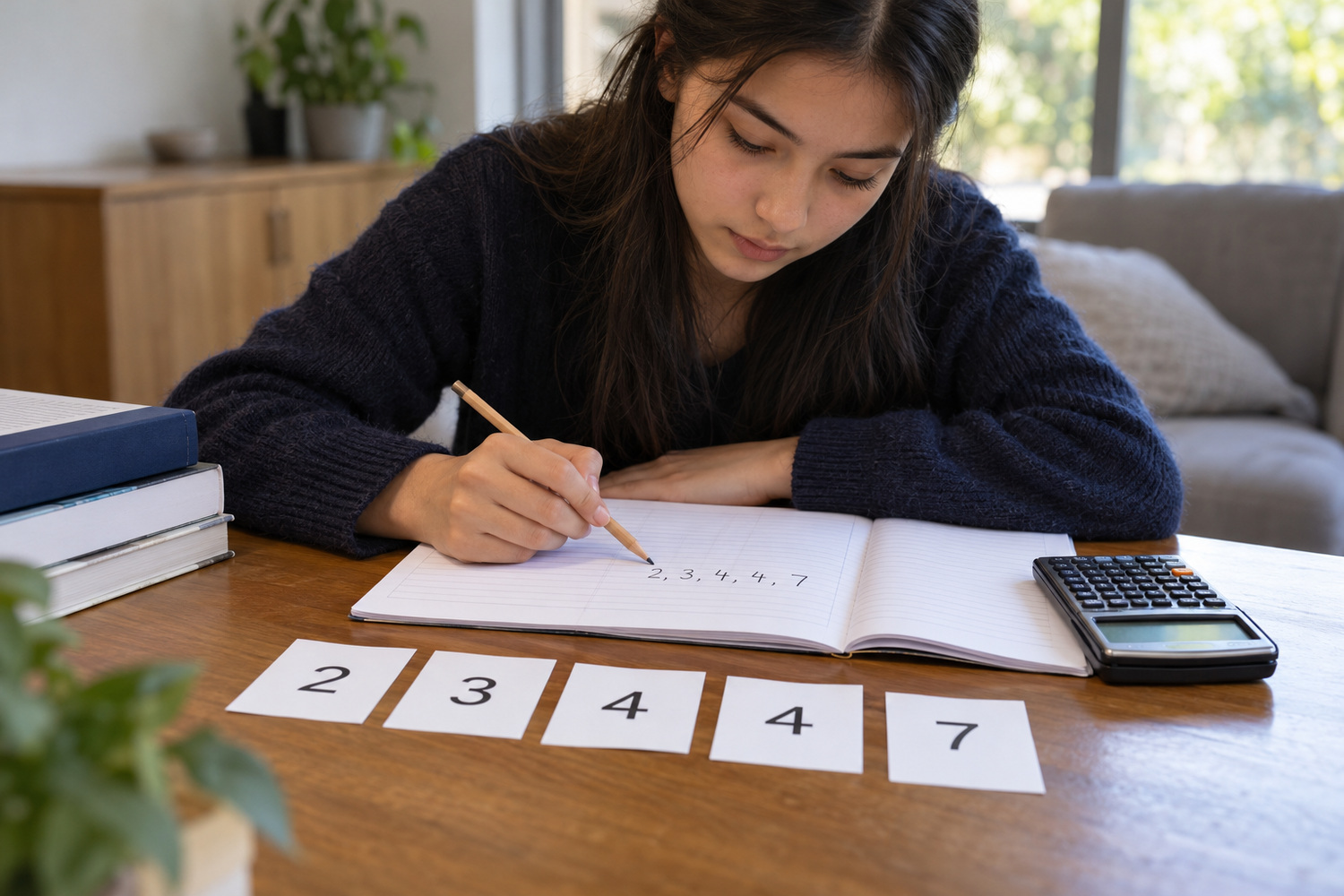
Use an error to find a specific skill to practise next.
Suppose you enter group A as 2, 3, 4 and 4, omitting the 7. The total is 13, and 13 divided by 4 gives a mean of 3.25 minutes instead of 4. One omission changes both the mean and the count, from five observations to four.
So check the entered list against all five original numbers first. Then name the skill you missed, which here is reading and entering data rather than finding a mean. Then try a separate small set and explain that result out loud.
This practice loop is editorial advice, not an official VCAA routine or a diagnosis.

Your school’s task notice and your teacher’s instructions settle what you may use while the task is being assessed. A practice worksheet, a tutor’s example or an article like this one never overrides them.
The assessed response has to be the student’s own. VCAA’s assessment advice tells teachers to consider the authentication strategies that suit each task, meaning the checks that the work is the student’s own. It points them to VCAA’s authentication rules in the VCE Administrative Handbook. Follow the school’s rules about help, feedback and permitted resources throughout assessment. Do not ask someone else to produce your assessed response.
Parents can organise separate practice and listen to the student explain a method. Keep that help separate from producing the assessed response.
If the notice is unclear about a permitted resource or the time allowed, ask the teacher about that exact rule.
After a separate practice question, try one sentence about what the answer means and one about its limits. Take any unclear step to your teacher. General Maths tutoring also offers SAC preparation and subject support; check the service page for lesson formats.
No. These are invented practice observations. The official application task has several variables and a modelling component; this miniature comparison covers only selected skills.
Do not assume so. Schools set tasks within VCAA’s requirements and tell students their conditions. Follow the notice and teacher instructions, and ask about any unclear rule.
Website design by CJ Digital
