
Your teacher writes a date on the board. There is a SAC in three weeks. Nobody stops to explain what that means, and the room reacts as though it is something more serious than a test.
SAC stands for School-assessed Coursework. It is an assessment task set and marked by your own school. The task type comes from the study design for your subject. In Units 3 and 4, the score your school gives you goes to the VCAA and feeds into your study score.
That last part is the whole difference. Everything else about a SAC looks like a test. Here is what one is worth, how the mark you are handed gets adjusted, and what happens when a SAC goes badly.
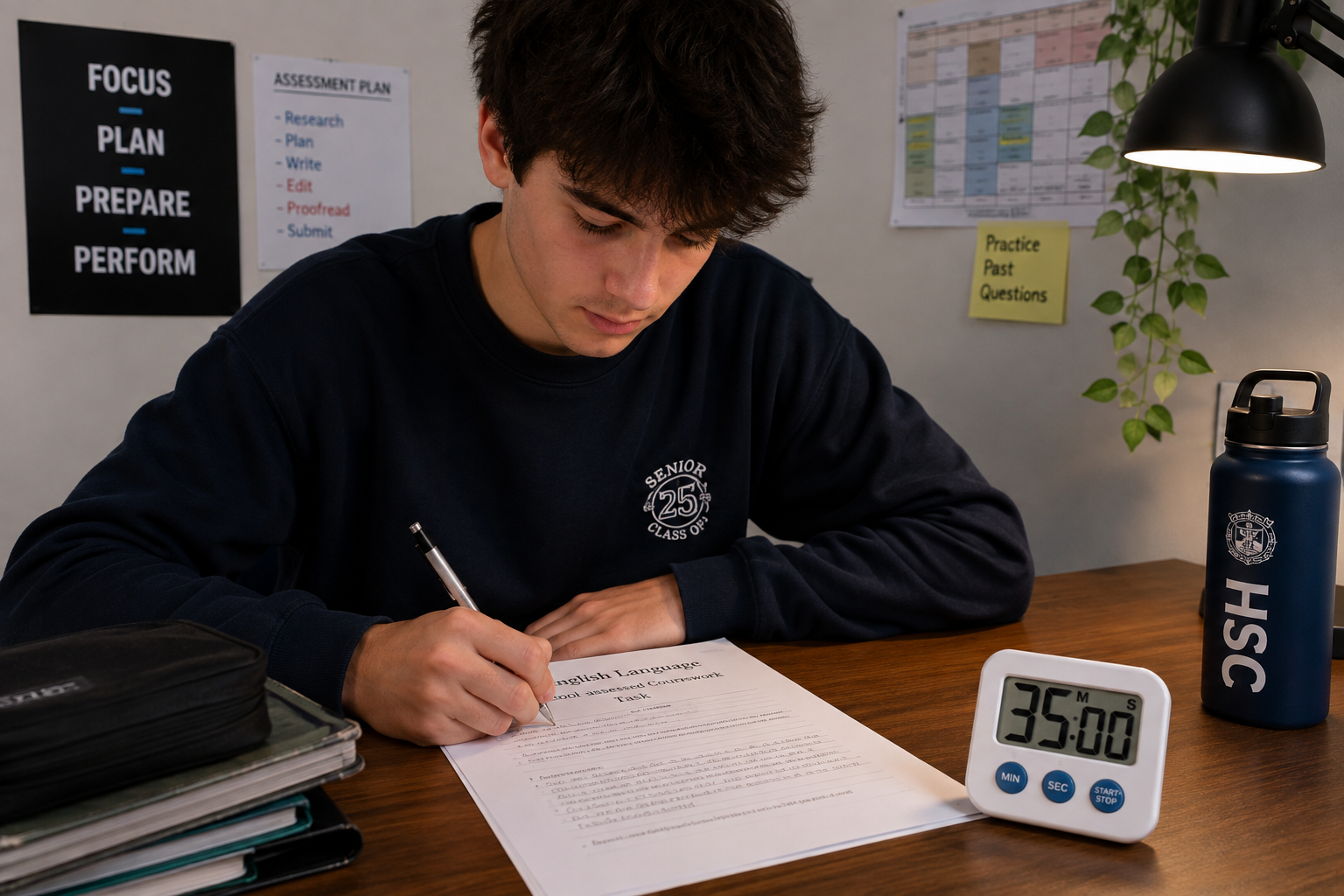
SAC stands for School-assessed Coursework. The Victorian Curriculum and Assessment Authority (VCAA) uses the term for a specific set of tasks. Those tasks measure your level of achievement against the outcomes in your study design.
A SAC is not a class test with a heavier name. Three things separate them.
|
|
SAC | Exam |
|---|---|---|
| Who sets it | Your school, from task types listed in the study design | The VCAA |
| Who marks it | Your teacher | Assessors appointed by the VCAA |
| When it happens | Through the year, mainly in class time | End of the academic year |
| What it is worth | Between 10 and 60 per cent of the study score, depending on the subject | The rest of the study score |
| What you control | The task type and the conditions are known in advance, so you can practise the exact thing | Preparation only. The paper is unseen and the conditions are fixed |
Not if the subject is Units 1 and 2. The VCAA treats the level of achievement in Units 1 and 2 as a matter for school decision. Those assessments are not reported to it. Only a satisfactory (S) or not satisfactory (N) result goes to the VCAA for those units.
So the number on a Unit 1 or 2 task does not follow you anywhere. Your school still marks it, reports it and uses it to judge whether you are ready for Units 3 and 4. None of it reaches your study score.
Three things are worth knowing here.
Units 3 and 4 are where the score starts to count. To be given a study score you need an S for both Units 3 and 4 in the same year. You also need at least two graded assessments in the study.
It depends on the subject, and the spread is wider than most students expect. Across the VCE studies with scored assessment in 2026, school-assessed coursework contributes between 10 and 60 per cent of the study score. There is no single figure. Any page that gives you one is quoting somebody else's subject.
Here are the 2026 contributions for eight commonly taken studies, as published by the VCAA.
| Study | Unit 3 coursework | Unit 4 coursework | External assessment |
|---|---|---|---|
| Accounting | 25% | 25% | Written exam 50% |
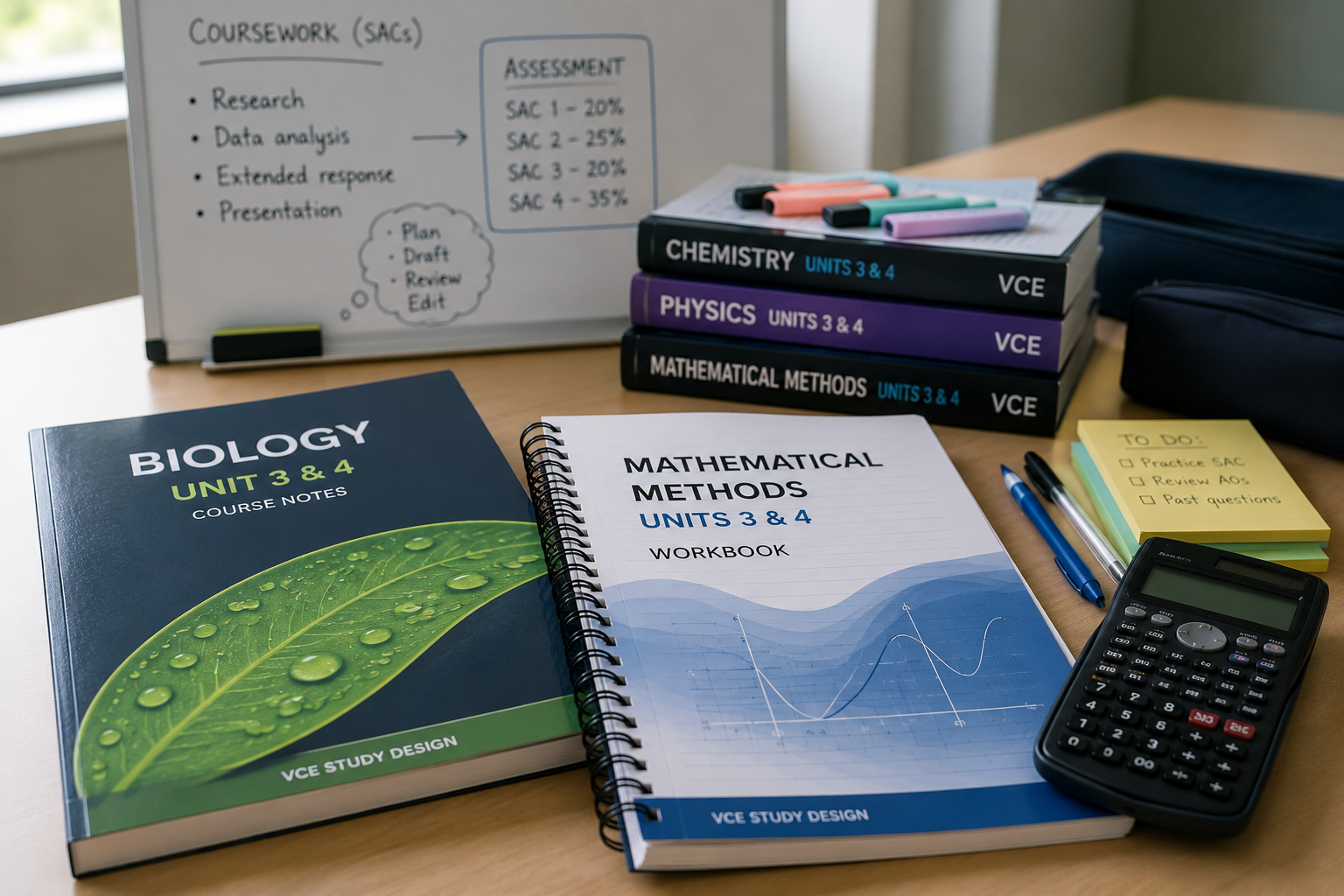
| Biology | 20% | 30% | Written exam 50% |
| Chemistry | 20% | 30% | Written exam 50% |
| English and EAL | 25% | 25% | Written exam 50% |
| Physics | 30% | 20% | Written exam 50% |
| General Mathematics | Units 3 and 4 combined, 40% | Exam 1 30%, Exam 2 30% | |
| Mathematical Methods | Units 3 and 4 combined, 40% | Exam 1 20%, Exam 2 40% | |
| Specialist Mathematics |
Units 3 and 4 combined, 40% | Exam 1 20%, Exam 2 40% |
Two patterns in that table are worth a second look.
In the sciences, the weight is not spread evenly across the year. Chemistry and Biology put 20 per cent on Unit 3 coursework and 30 per cent on Unit 4. Physics does the reverse: 30 per cent on Unit 3, then 20 per cent on Unit 4. The totals match. The shape does not. A Physics student's most valuable coursework happens in the first half of the year, and a Chemistry student's happens in the second.
The three maths subjects are built differently again. Units 3 and 4 coursework is one graded assessment worth 40 per cent, not two. There are also two exams rather than one.
Check your own subject rather than assuming. The contribution for every VCE study is published by the VCAA in the assessment summary of the VCE Administrative Handbook.
The mark your teacher hands back is an initial score. It is not final, and your school is required to tell you so.
The VCAA then applies statistical moderation. It takes the coursework scores your school awarded in a subject. Those scores are aligned against how the same group performed on the external exam. The point is comparability. A generous marker at one school and a hard marker at another should not change what a study score means.
Your moderation group is everyone doing that study at your school. That is why the same standard of work produces a different rank at different schools. A large, strong cohort is a harder field than a class of eight. Where only a handful of students take a subject, the school can partner with another school. The two groups are then moderated together.
The alignment uses four fixed points on each scale: the highest achievement, the upper quartile, the median and the lower quartile. The top moderated score is matched to the top external score, and the median and quartiles are matched the same way.
Statistical moderation does not change the rank order of students as determined by the school's school-based scores.
Victorian Curriculum and Assessment Authority
Two consequences follow, and neither is explained often enough.
One common worry is worth clearing up. Students who perform much worse in the exam than their coursework suggested are left out when the scales are aligned. One weak result in your class does not drag the rest of the group down.
Two different situations get called failing a SAC, and they lead to different places.
An N for the outcome means one of three things. The work did not demonstrate the outcome, a deadline was missed, or the work could not be authenticated. If you receive an N, your school must give you the chance to redeem it. The VCAA requires the teacher to provide further and alternative opportunities to show satisfactory completion. Those can include class work, homework, an extra task or a discussion. That other work does not have to be done under test conditions.
A low score is the more common situation, and it is where students get their hopes up. Redemption restores the S. It does not touch the score. The VCAA's wording leaves no room: students may not resubmit a school-based assessment task to improve an initial school-based assessment score.
So a poor SAC mark stays. Two things soften it. Most subjects spread coursework across several tasks and two units, so one weak result is a fraction of a larger total. And the mark buys you a rank position, not a percentage. The gap between you and the students around you matters more than the number.
If something goes wrong before the SAC rather than during it, the routes are an extension of time or Special Provision. Both go through your school, and both work far better before the task than after it. The eligibility rules and the maximum extension sit in your school's own policy, so ask for that policy rather than guessing at it.
One limit is worth stating plainly. An N for an outcome gives an N for the unit. Without an S for both Units 3 and 4 there is no study score. That is the point at which a SAC stops being about marks.
Because rank is what carries through moderation, the useful question is not how to get a good SAC mark. It is how to finish ahead of the people sitting the same SAC.
That changes what a hard SAC means. On a task the whole class finds difficult, the marks spread out, and losing a few costs you a place or two. On a task everybody finds manageable, the marks bunch together, and losing the same few marks can cost you five places. Easy SACs are riskier than they look.
The VCAA makes this point to teachers directly. Its advice on moderation warns that students who regularly score full marks bunch at the top. Good students then look equal to excellent ones. The excellent ones lose the chance to show the difference. Bunching is not neutral. It costs the students at the top.
The practical version is unglamorous. Find the task type in the study design before the SAC is set. Practise that exact type under the same time limit. Get one attempt marked against the criteria while there is still time to change something. Full practice SACs with worked solutions are in the shop. SAC preparation sessions run in the CBD, at Glen Waverley and online.
SAC stands for School-assessed Coursework. It is a set of assessment tasks set and marked by your own school. The task types come from the VCAA study design for your subject.
A SAC is a school-set assessment task that measures your level of achievement against the outcomes of a VCE unit. In Units 3 and 4 the score goes to the VCAA. It is statistically moderated and used to work out your study score. In Units 1 and 2 only an S or N result is reported.
Not if the subject is Units 1 and 2. Levels of achievement for those units are a school matter and are not reported to the VCAA. If you are taking a Unit 3 and 4 sequence in Year 11, that subject's SACs do count.
If you receive an N for an outcome, your school must give you a further opportunity to demonstrate satisfactory completion. That restores the S. You cannot resubmit a SAC to improve the score itself. A low mark is kept. It is one part of a total spread across several tasks and two units.
A SAC is set by your school from task types in the study design. A School-assessed Task is set by the VCAA and marked against VCAA criteria. It is an extended practical piece, such as a folio or a product. Nine studies have SATs: Algorithmics, Art Creative Practice, Art Making and Exhibiting, Data Analytics, Software Development, Media, Product Design and Technologies, Systems Engineering, and Visual Communication Design.
Website design by CJ Digital
