VCE Tutors Melbourne

The VCE Accounting exam technique that separates 40+ from mid-30s

Information current as of May 2026, verified against the VCE Accounting Study Design 2025–2029 and the 2024 VCAA Accounting examination report. 

The scenario looks familiar to anyone who has sat a Year 12 trial. A question worth eight or nine marks. Two-thirds of the marks come from a calculation. The rest comes from a written justification that sits underneath the working. The calculation goes in cleanly. The written justification gets one line, two if the pen is moving fast, and the answer book turns to the next question. 

From the assessor’s chair, that move is the one that costs the difference between a study score of 38 and a study score of 42. The 2024 VCAA Accounting examination report describes the pattern in plain terms: many students finish the paper on time, and performance varies because of misreading, imprecise terminology, and weak justification. 

This article walks through where the marks go missing on the VCAA Accounting exam, what 40+ scripts do differently, and how to train for it before October. 
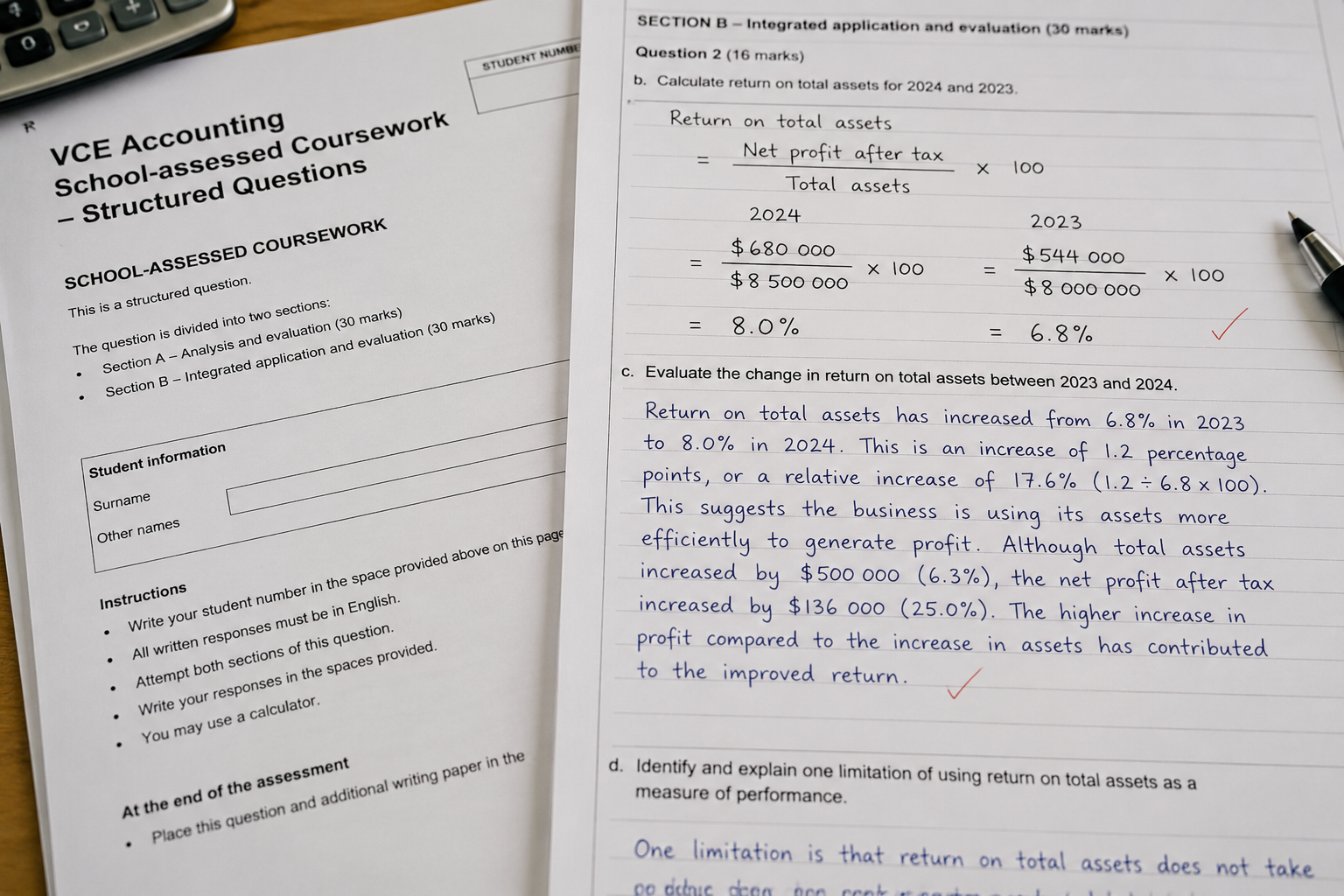
Study desk with accounting exam papers

Where the gap opens on the VCAA Accounting exam

The VCAA Accounting examination runs for two hours of writing time, with fifteen minutes of reading time before the pen comes down. The 2024 paper had eight questions worth a hundred marks in total, set against the current VCE Accounting Study Design (2025–2029). Every question carries multiple parts. Every question is compulsory. 

All eight questions combine short-answer recording tasks with longer extended-response tasks within the same paper. Marks for recording, justification, and discussion are spread across the parts of each question rather than separated into a multiple-choice section and an essay section. A single question can ask for an inventory card update, a journal entry, a written justification of an accounting principle, and a discussion of the business implications, with the marks split across the parts. 

The 2024 examination report makes the diagnostic point cleanly. Many students finish on time, and the students who don’t finish appear to skip questions because of content gaps rather than pace. The gap between mid-30s and 40+ rarely opens on routine recording: inventory cards in FIFO, standard journal entries from a clean source document, closing the Profit and Loss Summary. The cohort handles those well. 

The gap opens in the parts that ask students to do more than record. These are the parts that combine calculation with written justification, source-document interpretation, or qualitative analysis: 

  • Justification parts. A calculation produces a number. The follow-on part asks why a particular accounting principle, qualitative characteristic, or assumption applies, with a specific link back to the scenario. Generic answers cap below full marks regardless of how strong the calculation was. 
  • Discussion questions. The 2024 paper had one extended discussion question. Only about a quarter of students scored five or more marks on it. Discussion questions integrate financial indicators with broader business or ethical considerations and require both interpretation and a clear recommendation. 
  • Modelling questions. These have grown in complexity since the current Study Design was introduced and now appear regularly. Students who treat them as pattern-matching rather than reasoning lose marks here. 

What 40+ scripts do that mid-30s scripts don’t

Reading the 2023 and 2024 VCAA examination reports side by side surfaces a consistent pattern. The 40+ scripts work from the same content as middle scripts. Four habits are doing the heavy lifting, and middle scripts apply them inconsistently. 

A short comparison sets the shape of the difference before each habit is unpacked. 

Question type Typical mid-30s response Typical 40+ response
Justification of a journal entry “Recorded as expense to follow accrual basis.” Names the assumption, defines it briefly, and links it to the dates and amounts in the scenario.
Qualitative analysis (e.g. inventory turnover trend) “Inventory turnover is decreasing.” “Inventory turnover is slower, indicating inventory is sitting longer before being sold.”
Source-document recording One General Journal entry combining two source documents. Separate journal entries with separate narrations for each source document.
Extended discussion Lists financial points, then ethical points, then a recommendation. Integrates financial and ethical considerations across the same paragraphs, with a recommendation that engages both sides of the trade-off.

The four habits behind the table: 

  • Naming the principle, not just applying it. A 40+ script does not say “the entry follows the accrual basis.” It says: the accrual basis assumption requires the expense to be recognised in the period it was incurred rather than the period it is paid; in this case, the wages were earned in June, so the expense belongs in June even though the cash will leave the bank in July. The structure is consistent: name the principle, define it briefly, link it back to the scenario by name. Generic justifications cap at one or two marks regardless of how many marks the question is worth. 
  • Using the right terminology. The 2024 examination report flagged that students who described inventory turnover as “increasing” or “decreasing” were capped, even when their reasoning was sound. The correct terminology is “slower” or “faster.” The same discipline applies across the Study Design: working capital ratio, debt ratio, accounts receivable turnover, gross profit margin. Each indicator has its own approved language. Students who use the everyday word lose marks on questions where the underlying analysis is otherwise correct. 
  • Treating each source document as its own transaction. The 2024 report flagged that students were combining entries drawn from separate source documents. Each invoice, receipt, memo, or cash register summary is a separate event. It needs its own General Journal entry with its own narration. Narrations have to be on the entry and they have to be specific; they tell the assessor (and the next person to read the books) what the entry was for. 
  • Distinguishing recording from closing. Many students lost marks in 2024 by recording cash and inventory drawings directly in the Capital ledger rather than transferring the closing balance of Drawings to Capital. A 40+ script knows that recording a transaction and closing an account are two different operations. Drawings is its own ledger account during the year. At balance day, its balance is transferred to Capital through a closing entry, and the cross-reference in Capital reads “Drawings” rather than “Inventory” or “Bank.” 


The source document trap

A disproportionate share of mid-30s mark losses cluster on source-document interpretation. This is the cheapest area to fix, because the errors are reading errors rather than knowledge gaps. 

A typical VCE Accounting source document is an invoice, receipt, credit note, memo, or cash register summary. The numbers and labels on it carry information the question expects the student to extract. Readings tend to go wrong on four points: 

  • Dates. A date that straddles balance day flips the entry from a current-period transaction into an adjustment, or vice versa. A wages slip dated 27 June sits in this year. A wages slip dated 4 July might be part of a balance day adjustment for accrued wages. Settlement-discount terms (such as 5/7, n/30) put a hard date on when a payment qualifies for the discount. Reading the date wrong changes the journal entry, the ledger, and any flow-on calculations downstream. 
  • GST treatment. Some figures on a source document include GST and some exclude it. A $220 receipt with $20 GST produces an inventory cost of $200, not $220. Mixing the two ends in a wrong cost of sales and a wrong inventory card. The 2024 exam report flagged students who omitted GST entirely from a disposal entry, a recurring high-frequency error. 
  • Discounts. Discount Allowed (offered to a customer who pays early) is a separate ledger account from Discount Received (taken from a supplier). The two are not interchangeable. Settlement discounts also need to be reversed against either Sales (if allowed) or against Inventory or Cost of Sales (if received), depending on which side of the transaction the business sat on. 
  • Drawings against expense. A receipt for fuel might be a vehicle expense. The same receipt might be drawings if the vehicle is the owner’s private car. The source document and the question stem together tell the student which it is. Misreading this turns a profit-affecting transaction into an equity-affecting one, and the flow-on effect runs through the Income Statement, the Balance Sheet, and the Cash Flow Statement. 

Catching these errors comes from highlighting the date, the GST line, the description, and any unusual terms (settlement discount, on credit, balance owing) before any number gets written into a ledger or journal. The fifteen minutes of reading time on the actual exam is the opportunity to do this work without burning writing time. 

How to practise the way an assessor marks you

What separates 40+ practice from middle practice is what happens after the paper is finished. Each paper is worth more when the marking matches how an assessor would read it. 

  • Use the VCAA examination reports as the source of record. Each year’s report names the high-frequency errors from that year’s cohort, with worked examples of what got full marks and what got capped. Reading the last three reports for VCE Accounting (2022, 2023, 2024) is more useful than half the textbook chapters. The reports also surface terminology drift; they will tell a student that “decreasing” is wrong for a turnover ratio before any tutor will. 
  • Mark your own work against the published assessment criteria. Marking guides published by tutoring companies and trial exam suppliers vary in quality. The VCAA exam reports do not. When marking a past paper, work through the official report part by part and tick each marking point off only when the student response contains it: the principle named, the link to the scenario, the correct terminology, the closing reference. Self-marking that gives the benefit of the doubt is worse than not marking at all, because it confirms a habit that the assessor will flag. 
  • Run a time budget per mark. The exam is 100 marks across 120 minutes of writing time, which works out to roughly 1.2 minutes per mark as a baseline, with the fifteen minutes of reading time ahead of it for question selection and source-document highlighting. Short-answer parts under five marks should run faster than the average. Discussion questions and longer extended-response parts run slower. The skill the time budget builds is recognising when a part is taking too long and parking it before the next question’s marks are at risk. 
  • Practise written justifications cold. The calculation is the part that holds up under exam pressure. The written justification is the part that breaks. A student who can write a perfect justification in a quiet room may produce a one-line answer when the clock is on. Practising the writing without doing the calculation, or after doing it the day before, separates the skill that gets graded from the skill the student is more comfortable with. 
  • Run a SAC post-mortem the same week the SAC is returned. Every question on a SAC that didn’t get full marks goes onto a list, with the principle, the term, or the recording rule that the question was testing. The list grows from August into trial week. By the time the trial paper lands, the patterns repeat, which is the point of keeping the list. The exam tests the same principles in different scenarios. 

Where this leaves you before October

The VCAA written examination window for 2026 runs from Monday 26 October to Wednesday 18 November. The exact date for VCE Accounting will be published by VCAA in May. Before that, schools across Melbourne run their trial exam window through August and into early September, and the trial paper is the last full read on technique before the real one. 

Two things are worth doing in the next term and a half. The first is reading the most recent VCAA Accounting examination report cover to cover, with a highlighter, and writing down every error pattern that applies to recent SAC work. The second is finding a marker who reads a script the way a VCAA assessor reads it: for the link between principle and scenario, for the precise terminology, for the difference between recording and closing. 

Every tutor at VCE Tutors Melbourne is a trained VCAA assessor who scored in the high 40s to 50 in their own VCE. The Accounting program runs to a raw 40+ result, with a refund guarantee if it doesn’t get there. If a student is sitting in the mid-30s after the most recent SAC and wants the gap to 40+ closed before the trial paper, that is the conversation worth having. 

For 1-on-1 accelerated VCE Accounting support, see the Accounting program page. For exam and SAC marking against VCAA assessment criteria, see the exam and SAC marking services page. 

Testimonials

Raw Score

Expert VCE Accounting tutors in Melbourne helping students achieve raw 40–50 scores with structured support, exam strategies and clear, personalised guidance. 

VCE Tutors Melbourne
Raw

Expert VCE Accounting tutors in Melbourne helping students achieve raw 40–50 scores with structured support, exam strategies and clear, personalised guidance. 

VCE Tutors Melbourne
Raw Score

Expert VCE Accounting tutors in Melbourne helping students achieve raw 40–50 scores with structured support, exam strategies and clear, personalised guidance. 

VCE Tutors Melbourne
Raw
44
Angus
John Monash Science School
Class of 24
Climbed 2-3 ranks in over four months equal to about 4 study scores.
Won't use the
raw score
Erin
Caulfield Grammar School
Class of 25
Improved by 8 study scores based off her first SAC to her final exam.
Raw
44
Chantelle
Suzanne Cory High School
Class of 26
Improved by 7-8 study scores based off SAC scores and scoring A+ on both parts of the exam.
Raw
44
Dhairya
Suzanne Cory High School
Class of 26
Maintained a Rank 2 in SACs at a top school to a final study score of 46
© 2026 VCE Tutors Melbourne

Website design by CJ Digital