
Someone has told you Chemistry scales well. A teacher, a friend's older sibling, a subject selection night. What nobody explained is what that sentence means, or what it costs to get the benefit.
Yes, VCE Chemistry scales up. In the 2025 VTAC scaling report, a raw study score of 30 became a scaled 34, and a raw 40 became a scaled 44. That is about four extra points through the middle of the range. It is not a free lift, though. Chemistry scales up because of who else sits the subject, and the gain shrinks to nothing at the top.
Here is what the current figures are, where the scaling stops helping, and how to judge the trade. It applies whether you are picking subjects in Year 10 or already sitting in Unit 3.
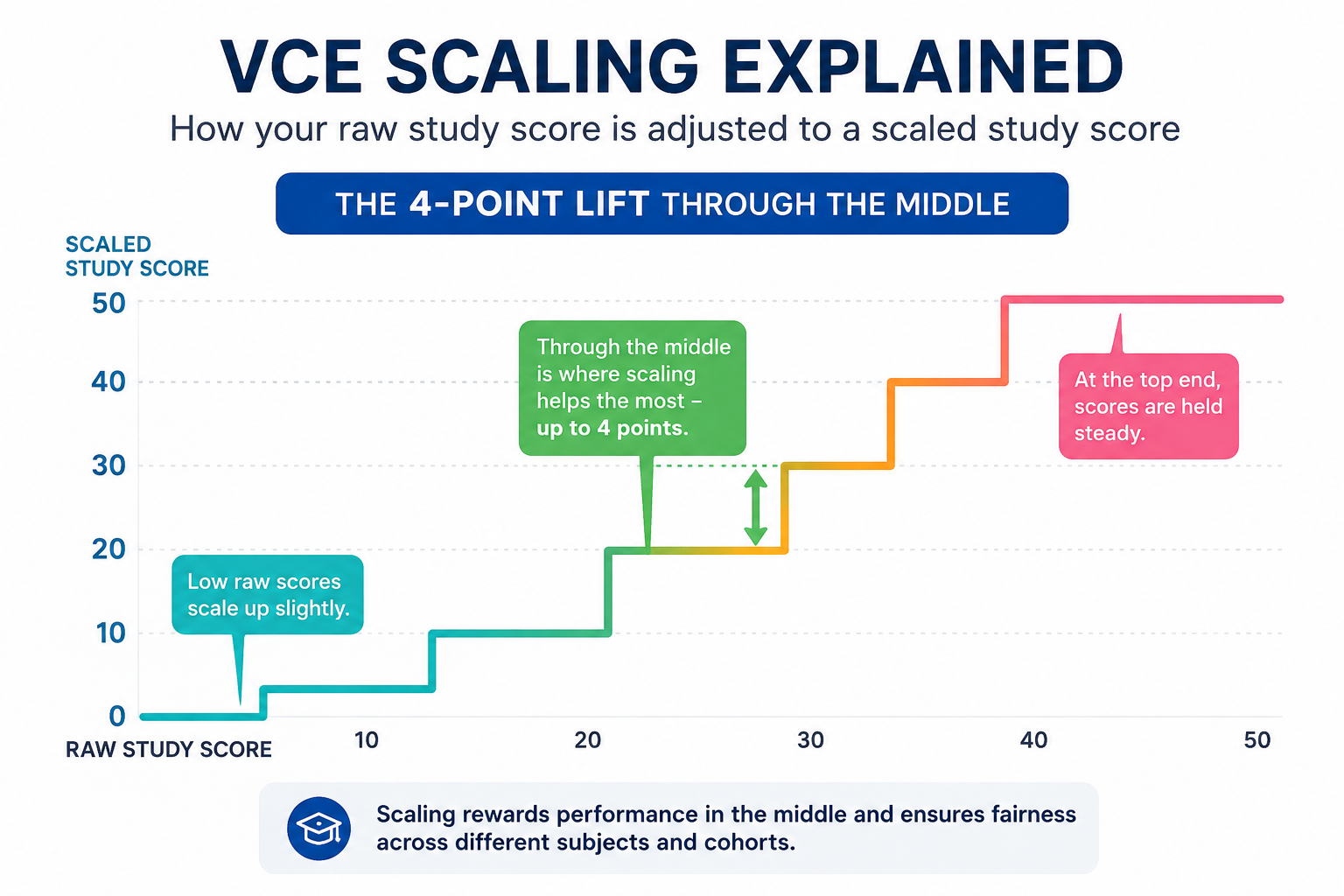
Scaling is the adjustment VTAC makes to your study score before it goes into your ATAR. Your raw study score comes from VCAA. Your scaled score is what VTAC turns it into.
Chemistry scales up. Its scaled mean in the 2025 VTAC scaling report was 33.6. VCAA sets the raw mean at 30 for every study, so Chemistry moved up by about three and a half points. That made it the highest scaling of the mainstream VCE sciences that year.
Here is what each raw score became, straight from the report.
|
Raw study score |
Scaled score, 2025 | Difference |
|---|---|---|
| 20 | 22 | +2 |
| 25 | 28 | +3 |
| 30 | 34 | +4 |
| 35 | 39 | +4 |
| 40 | 44 | +4 |
| 45 | 47 | +2 |
| 50 | 50 | 0 |
The gain is not the same at every level. That is the part most scaling advice leaves out.
Through the middle of the range, Chemistry added about four points. A raw 30 became a 34. A raw 40 became a 44. Then the gain falls away. At a raw 45 it was two points. At a raw 50 it was nothing, because 50 is the ceiling and nothing scales past it.
The scaling gain is biggest in the middle. A raw 30 picked up four points in 2025. A raw 50 picked up none.
That changes what scaling means for different students.
Those four points land in your aggregate, and only if Chemistry finishes among your better subjects. VTAC counts your best English score and your next three highest scaled scores in full. It then adds 10 per cent of a fifth and sixth. A Chemistry score that lands fifth contributes a tenth of its scaled value, and the four points shrink to less than one.
A scaled 40 in Chemistry sat just above a raw 35 in 2025. In General Maths, which scales down, a raw 40 came out at 38. The same scaled 40 needs a raw score well beyond that. The distance between those two subjects is the clearest way to see what Chemistry scaling is worth.
VTAC does not scale a subject up because it is hard. It scales a subject on how the General Mathematicsthe same subject that year.
The Chemistry c ohort tends to score well in everything else it takes. That is why the subject moves up. There is more on the mechanism in a separate guide to how General Maths scaling works.
Here is the honest consequence. Your study score is a rank, not a mark. VCAA sets every subject to a mean of 30 with a standard deviation of 7, and most students finish between 23 and 37. The same cohort strength that lifts Chemistry afterwards is the field you have to outrank first.
Scaling pays you back for sitting in a strong field. It does not make the field any easier.
Here is how Chemistry compared with the other sciences in 2025.
| Study | Scaled mean, 2025 | Raw 30 became | Raw 40 became |
|---|---|---|---|
| Chemistry | 33.6 | 34 | 44 |
| Physics | 31.7 | 32 | 42 |
| Biology | 30.5 | 31 | 41 |
| Psychology | 28.4 | 28 | 39 |
Source: 2025 VTAC scaling report.
Half your Chemistry study score comes from school work and half comes from one exam.
The VCE Chemistry Study Design is accredited for Units 3 and 4 from 2024 to 2027. Under it, School-assessed Coursework contributes 50 per cent and the end-of-year exam contributes the other 50 per cent. There are five SAC tasks worth 10 per cent each: two in Unit 3 and three in Unit 4. The last is a scientific investigation you design and run yourself, reported as a scientific poster with a logbook.
One rule inside that structure catches students out. Four of the five tasks are not fixed by VCAA. Your school chooses the task type for each, and a task type can only be used once across Units 3 and 4. The formats your school picks early close off options later. If Unit 3 gives you a data analysis task, that task type is gone for the rest of the year.
The exam runs for 2 hours and 30 minutes, with 15 minutes of reading time. It is worth 120 marks across two sections.
You are given a Data Book and allowed one scientific calculator. There is no CAS.
The Data Book is not just a reference you dip into. VCAA publishes a fresh edition each year, its contents are numbered, and exam questions send you to specific items by number. The 2025 paper sent students to item 13 for enthalpies of combustion, item 7 for redox colours, and item 1 for the electrochemical series. Knowing the layout well enough to land on the right page is part of the exam, not preparation for it.
Section B questions are long. In 2025 the seven of them ran from 8 to 17 marks each. That shape matters when you are deciding whether to take the subject. One shaky area of study does not cost you a mark here and there. It can cost a 17-mark block in one hit, and the multi-part structure means an early slip is carried through the parts that follow.
The paper is also direct about how marks are awarded. Working must be shown, and a wrong numerical answer with no working scores nothing. Answers have to be simplified and given to a sensible number of significant figures. Equations must be balanced and must show states. Each of those is a rule you can follow without knowing any more chemistry.
Chemistry is not the right subject for everyone who could pass it. There are four situations where the scaling does not justify the cost.
The worst reason to take Chemistry is that it scales. Four points is not worth two years in a subject you cannot get out of bed for.
Scaling is the last thing that happens to your score, and it is out of your hands. VTAC publishes the scaling report each December, once results are out. It applies that year's figures to a number that is already fixed.
What builds that number starts far earlier, and one step in it goes largely unmentioned. VCAA runs statistical moderation on every school's SAC marks. It lines up the spread of a school's coursework marks with how that school's Chemistry students perform in the external exam. Your position within your school is protected. The marks around your position move.
Two things follow. Your SAC rank matters more than the mark your school writes on the paper. And your result is tied to how your whole Chemistry class performs in the exam. That is why the same study design produces such different outcomes across Melbourne schools.
The first Unit 3 SAC usually lands in Term 1. That is where the raw score starts being built. It is also the earliest point at which a shaky topic can be fixed rather than carried into the exam. If Chemistry is the subject holding your aggregate back, Chemistry tutoring is built around lifting the raw score. That is the half of the equation you can move.
Yes. In the 2025 VTAC scaling report, a raw 30 in Chemistry became a scaled 34 and a raw 40 became a scaled 44. The subject's scaled mean was 33.6, above the raw mean of 30 that VCAA sets for every study.
They are hard in different ways, and the scaling reflects the cohort rather than the workload. Biology scaled close to level in 2025, with a scaled mean of 30.5, while Chemistry sat at 33.6. Chemistry carries far more calculation and Biology carries more written explanation. Students who find worded answers easier than mole calculations often do better in Biology.
Based on the 2025 figures, a scaled 40 sat just above a raw 35. A raw 35 scaled to 39 and a raw 40 scaled to 44. These numbers shift every year, so check the current scaling report before you plan around them.
Half. The end-of-year exam contributes 50 per cent. Five SAC tasks across Units 3 and 4 contribute the other 50 per cent, at 10 per cent each. The exam is a single 120-mark paper sat at the end of the year.
Website design by CJ Digital
